Biological Anthropology is unique in straddling both Anthropology and the biological sciences more broadly. For both of these fields, the University of Cambridge is considered by many to be the world-leading institution offering the best possible environment to students wanting to study or conduct research in Biological Anthropology.
In 2020 Cambridge ranked first in the world for biological/life sciences in The Times Higher Education World University Rankings and first in the UK according to the Complete University Guide, QS University Rankings and Guardian University Rankings.
In Anthropology, Cambridge ranked first in the UK according to the Complete University Guide and second in the world in the QS World University Rankings.
What is Biological Anthropology?
Anthropology is the study of humans in comparative perspective – comparing societies and cultures, looking at change over time, and exploring human biological diversity. Biological Anthropology takes this comparative approach to exploring human evolution and adaptation: comparisons between humans and other animals to understand human uniqueness and biological variation, comparisons across time to unravel the evolutionary history of hominins over the last 6–8 million years, investigating variation in human development and health, exploring the mechanisms that generate population differences today and in the past, and looking at individual behaviour in terms of evolution and adaptation and its underlying cognitive basis.
What do biological anthropologists do?
Biological Anthropology is an extremely diverse field – in a sense, it encompasses all the biological and behavioural sciences, but focuses on humanity. So, biological anthropologists can be palaeontologists, geneticists, archaeologists, ecologists, physiologists, ethologists, epidemiologists, osteologists, among others! Most people in the subject do fieldwork, sometimes in relatively remote places. This may involve observing gorillas and/or chimpanzees in the Congo, tracking the routes taken by ancient hominins in eastern Africa, mapping gene and language boundaries in Australasia and the Pacific Islands, collecting skeletal data in top-tier museums across Europe, investgating child health and growth in South Africa, or excavating archaeological sites in places like Iraq, Kenya, Vietnam and South Africa.
What are the applications of Biological Anthropology?
Understanding human variation as a product of evolution has many applications outside of academia and further research. For instance:
- Anthropometry (the measurement of human body form) has applications in industries that require body proportions to be accounted for, as in the clothes, military, sports and factory work industries,
- The scientific study of our bodies in motion, Kinanthropology, offers important insights for sports companies relating to maximum physical potentials, biochemistry and physiology, and musculoskeletal anatomy
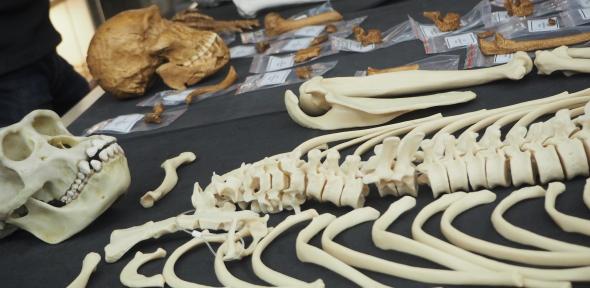
- Through the study of human remains, understanding how a profile of a deceased individual can be drawn from excavated bones and teeth can prove useful in commercial archaeology and forensic casework (either relating to accidents/crimes, or larger-scale contexts of wars or genocides)
- Human origins and the process of dispersal of modern and ancient humans around the world gives us useful knowledge in the clinical and medical fields, by informing us on worldwide health variation, the relationships between age, nutrition and disease, knowledge of defective genes, and susceptibility/resistance to diseases
- An education in Primatology (the study of our closest relatives in the animal world, especially monkeys and apes) can be important for conservation, epidemiology and tourism.
- Human ecology and evolution contribute unique perspectives and knowledge that is useful for understanding the interaction between humans and their environment, as well as the impact of climate change on individuals and societies around the world.
Altogether, Biological Anthropoology also trains you to look at things analytically and become cognizant of human cultural and biological diversity. In the context of human evolutionary studies or comparative biology, you may find a useful frame of reference to develop statistical and analytical skills, as well as to hone your creative thinking and critical reading.
Explore how you can study Biological Anthropology at Cambridge as an undergraduate or postgraduate student.